Picture a quarterly business review where the marketing team reports that brand mentions are up 40%. It sounds strong, and for a moment, it holds. Then the question comes: what does that mean for ROI?
This is where the conversation starts to break down. Brand mentions prove that your brand is being talked about, but they don’t exactly show the value of that attention, who it’s reaching or what it’s contributing to the business.
Today, 74% of CMOs face increased scrutiny to prove marketing ROI. Yet brand mentions remain one of the most commonly reported metrics, largely because they’re easy to collect and present. The issue isn’t accuracy, it’s that they only show part of the picture.
For senior leaders, visibility alone doesn’t tell them enough. Instead, they need to understand the impact behind that visibility.
In this blog, we explore how brand mentions should be used, how to connect them to business outcomes and the five leadership questions that need a more complete view of performance.
Get the Survival Guide for PR Monitoring & Reporting
The Appeal of Brand Mentions—and Why They Made Sense
Before digital tools existed, tracking brand visibility meant manually collecting press clippings. With the arrival of Google Alerts and the rapid expansion of social media, the reporting process transformed entirely thanks to marketing technology. For the first time, brands could use media monitoring tools to quantify how often they were being mentioned across channels.
What Are Brand Mentions?
A brand mention—or media mention—is any reference to your brand across digital channels—whether an online article, a social post, a video mention or even a print mention. It’s a volume metric that measures how often your brand enters the conversation and is often used by marketing and PR teams.
It was a genuine step forward because brand mentions gave teams a clear view of visibility. They made it easy to track how much attention a campaign generated, which product launches drove the most coverage and whether your brand was being picked up more or less than competitors during key moments like fashion week or major drops.
But while measurement capabilities evolved, expectations moved faster and volume alone is no longer enough to answer the questions leadership are asking.
What the “Impact Gap” Costs You
Proving ROI is now the single biggest barrier to brand marketing investment—ranked above budget flexibility, economic uncertainty and short-term pipeline pressure. This makes it imperative to move beyond surface-level metrics and towards a clearer, data-driven view of brand performance that ties to facilitating the business’ goals.
Brand mentions are an excellent start for showing the reception of your activities. Between spikes around campaigns, a higher number of placements and increased activity across channels overall, these suggest momentum for your brand. But what’s missing is whether these placements carried any weight, which channels and creators drove the most value, and how that impact compares across your activities.
This is where brand mentions lag in understanding what delivered a tangible return. It starts to open questions about how your budget is allocated toward channels and creators generating the most placements. For instance, a product launch garnering buzz through influencers may appear as strong performance—but how can it confirm whether that activity is reaching the right audience or was simply just noise? Could fewer editorial pieces have provided more crediblity with the right audience, rather than using most of the budget on influencers?
In fact, without clear insights your strategy could be costing you more than you know. Having inefficient allocation, where investment looks active but doesn’t indicate a clear ROI of your activities is often something senior leaders notice, particularly when it comes to budget discussions.
But brand mentions—and other vanity metrics such as number of placements and reach— still have a role to play as a signal of activity. What’s missing is a layer that quantifies and qualifies the value of each placement.
Media Impact Value® (MIV®): Moving from Volume to Value
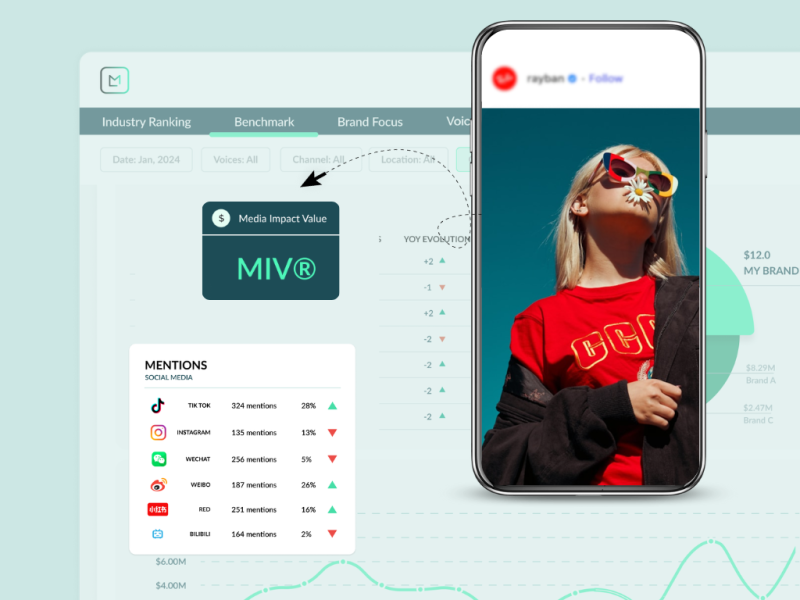
Media Impact Value® (MIV®) is our proprietary metric that assigns a monetary value to placements across social media, online publications and print channels. Rather than focusing on how often a brand is mentioned, it allows teams to understand what that visibility is worth.
What makes MIV a powerful metric is its ability to provide an apples-to-apples comparison of placement types. Using a consistent framework, it evaluates performance across different channels and Voices—Media, Influencers, Celebrities, Partners and Owned Media—to put all these on a level playing field. This enables a much smarter analysis to tell you who is driving impact, where that impact is happening and how much value it generates.
Example of MIV in Practice
In our Market Expansion Strategy for 2026 report, we looked at how skincare brand BYOMA performed across regions. When broken down by MIV and Voice, the differences are clear.
In the U.K., the brand generated $16M in MIV, with a Voice Mix led by Media (40%) and Influencers (45%). Meanwhile in the U.S., MIV reached $28M, with Influencers driving over 70% of total value—outperforming its home market.
On the surface, both markets show strong activity. But the way that value is built tells a different story. In the U.S., performance is being driven by Influencers at scale, accelerating reach and visibility. In the U.K., Media plays a much stronger role, building credibility and reinforcing the brand’s position in its home market.
This shows that growth isn’t about repeating the same strategy everywhere. It’s about understanding what each market requires—using Influencers to scale visibility in newer markets, while relying on Media to build credibility where brand perception matters most.
👋🏽 Have a look at how cross-regional marketing works within the Launchmetrics platform in our product blog.
Five Leadership Questions Brand Mentions Can’t Answer Alone, But MIV Can
Brand mentions and other surface-level metrics show that your brand is part of the conversation. But for Fashion, Lifestyle and Beauty brands, leadership wants to understand what that attention is worth, where it’s coming from and how it translates into performance.
Below, we walk through five key questions senior leaders are asking, where brand mentions add value and MIV starts to provide the answers.
1. What is this visibility actually worth?
Brand mentions show how much activity your brand generated, but not what that activity is worth to your business. MIV assigns a monetary value to every placement across print, online and social, putting all coverage on a consistent scale for easy comparison.
Example: Take DSQUARED2 at Milan Men’s Fashion Week FW26. The show generated $19.5M in MIV across 2.4K placements. On the surface, that’s strong visibility but one moment alone, Hudson Williams opening the show, generated $10.9M in MIV, over half of the total impact.
Insight: This shows that performance wasn’t driven by the volume of placements, but by a single high-impact moment. If you were only looking at mentions, you’d assume the entire show contributed evenly. In reality, most of the value came from one decision—casting—and that’s what you’d double down on next time.
2. What is driving our performance?
Brand mentions show that something happened, but not what created that buzz. MIV, combined with others metrics such as Voice Mix and Channel Mix, can show which channels and Voices are actually contributing the most value to your brand performance.
Example: At Coachella 2026, SKYLRK generated $2.3M in MIV from its on-site pop-up and capsule activation. On the surface, this looks like a successful strategy, naturally giving credibility to the in-person consumer experience. But the majority of that impact was tied to Justin Bieber’s headline performance, where the brand was worn on stage and became part of the wider “Bieberchella” moment, which generated $117.4M in MIV overall.
Insight: This shows that the activation itself wasn’t the main driver of value. The impact came from being tied to the right moment. If you were only looking at mentions, you’d credit the activation. In reality, it was the context around it that created the result—and that’s an example of what leadership would need to recognize when understanding what actually drove performance.
3. What does this say about how we’re spending?
Brand mentions show where activity is happening, but not whether spend is being used effectively. MIV, combined with MIV per placement, can show how much value each channel and creator is delivering.
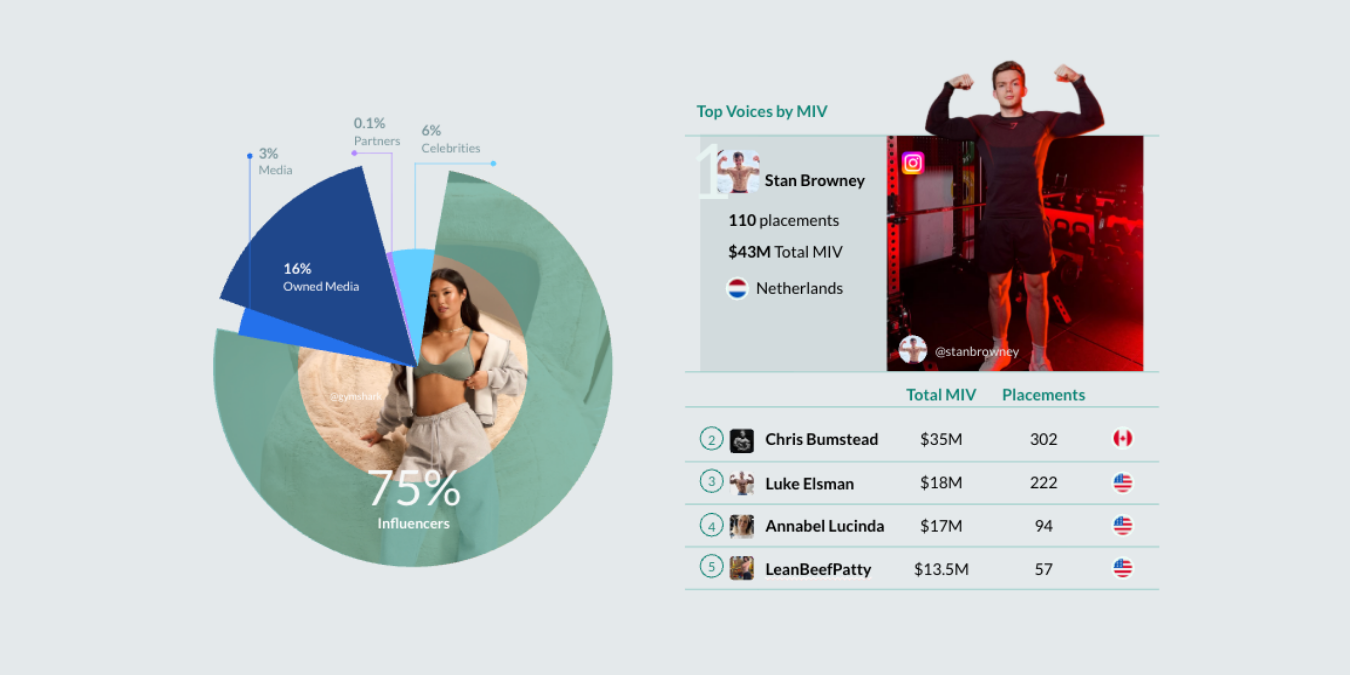
Example: In our Market Expansion Strategy for 2026 report, it revealed how Gymshark generated over $402M in MIV with 75% coming from Influencers. Interestingly, while All-Star Influencers accounted for 55% of the total impact, one long-term partnership delivered $43M in MIV across 110 placements—that’s $391K MIV per placement. Netherlands creator, Stan Browney, had a strong resonance with its U.S. audience through his content, helping to amplify the brand in this region.
Insight: This shows that most of the return isn’t coming from the full influencer strategy, but from a select group of high-performing partnerships. If you were solely looking at brand mentions, your investment into Influencers would appear to be working at scale. However, you may be funding a large volume of activity that could only be contributing relatively little, while a small number of creators may be doing the heavy lifting instead. That’s where spend could be challenged or more strategically concentrated in leadership conversations.
4. Are we improving, or just doing more?
Brand mentions show that activity has increased over time, but not whether that growth is delivering value. Your MIV evolution can show whether performance is building—or simply just noise.
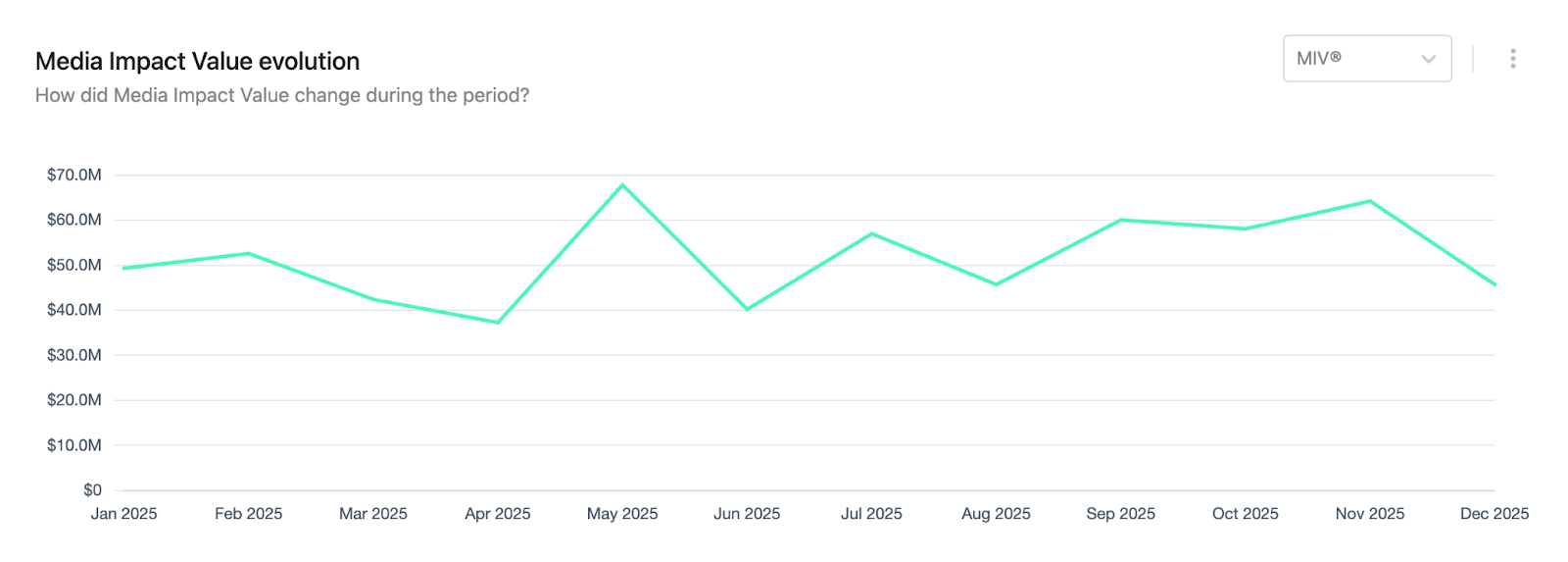
Example: Looking at Rhode’s 2025 performance within Launchmetrics, May saw the largest rise in placements, climbing to nearly 10K—around the same period as the brand’s $1B acquisition by e.l.f. Beauty. MIV also reached its highest point that month, close to $70M. But the more interesting story comes after that. Placements stayed relatively high from September to November, yet MIV moved slightly differently, showing that not every increase in activity carried the same value.
Insight: This shows leadership whether growth is efficient or just busy. If you were only looking at placements, the later months would all look similarly strong. But with MIV, it shows where activity is actually converting into value, helping teams understand which moments deserve more investment and which ones are simply adding volume.
5. How do we compare to competitors?
Brand mentions show your presence in the conversation, but not whether you are outperforming competitors. MIV, alongside our brand ranking capabilities within Launchmetrics, shows how much impact your brand owns relative to others. This makes it even easier to see how your brand ranks against others, particularly in highly competitive moments in the event calendar.
Example: At the Met Gala 2025, India’s leading luxury brand Sabyasachi ranked among the top-performing brands with $20.2M in MIV, competing alongside global luxury houses that consistently dominate the event year after year. When you look closer, that impact was driven largely by a single cultural moment—dressing Shah Rukh Khan, the “King of Bollywood,” whose appearance alone generated $19M in MIV and dominated the top men’s looks ranking.
Insight: This shows that while many brands may generate similar levels of visibility, not all are driving the same level of impact. In reality, Sabyasachi’s ranking was driven by one ambassador with significant cultural pull. It highlights how finding the right face—even for a first appearance—can carry more impact than showing up consistently or scaling activity across multiple placements. This level of insight gives leadership a deeper understanding of the impact of ambassadorships, how that translates into brand performance against competitors and ultimately what it means for ROI.
Move Your Brand Measurement Forward
At a leadership level, decisions aren’t made on volume alone, but rather understanding what that activity is worth, what is driving it and how it compares across markets, channels, Voices and competitors. Doing this requires the right data and technology.
Launchmetrics brings this level of analysis into one view. By combining media monitoring with benchmarking, teams can track coverage, assign value through MIV and break down performance by Voice, channel and market. If you want to understand how to move from tracking mentions to measuring the impact of that performance, our PR monitoring guide is a great start to how brands today should be tracking their media mentions and putting a value to their performance.
PR Monitoring & Reporting Survival Guide
Learn how to turn media monitoring into a strategic lever that fuels your brand performance.
Pawandeep Kaur is a Fashion, Lifestyle and Beauty content expert and Senior Content Marketing Manager at Launchmetrics, with over seven years of experience in content marketing and thought leadership across retail, ecommerce and the Fashion, Lifestyle and Beauty market. She specialises in brand visibility, influence and cultural relevance across key cultural moments, marketing campaigns and events, translating performance data into strategic insight for the FLB market.
Across her career, she has led content, thought leadership and customer case studies in collaboration with global brands and agencies including KIKO Milano, Clarins, Pets at Home, Amazon, eBay and AKQA, helping brands translate strategy, performance and customer success into industry stories.