Media tracking was once focused on monitoring press mentions and campaign coverage. Today, Fashion, Lifestyle and Beauty (FLB) brands use it to measure how they appear across the biggest cultural moments in the calendar. From fashion weeks and the Met Gala to Coachella and Wimbledon, these events create huge opportunities for brands to be at the center of conversation.
2026 has already delivered iconic examples of how quickly brands can become part of the narrative. From SKYLRK winning with “Bieberchella” or the viral “Benito Bowl” conversation around Bad Bunny wearing Zara, overnight buzz can translate into major brand value. But while brands invest heavily in celebrity dressing, partnerships, activations and campaigns around these moments, many still struggle to measure what that exposure actually delivered for the brand.
In this guide, we’ll break down how to approach media tracking before, during and after major cultural moments, helping teams benchmark performance, monitor coverage in real time and build stronger post-event reporting to inform future strategies.
Map the Moments that Matter
Every marketing and PR team operates with finite budgets, meaning every activation, campaign and partnership comes with a need to prove ROI. But with multiple events, campaigns and partnerships happening throughout the year, many teams struggle to keep track of which activities are actually driving the most attention and value for the brand.
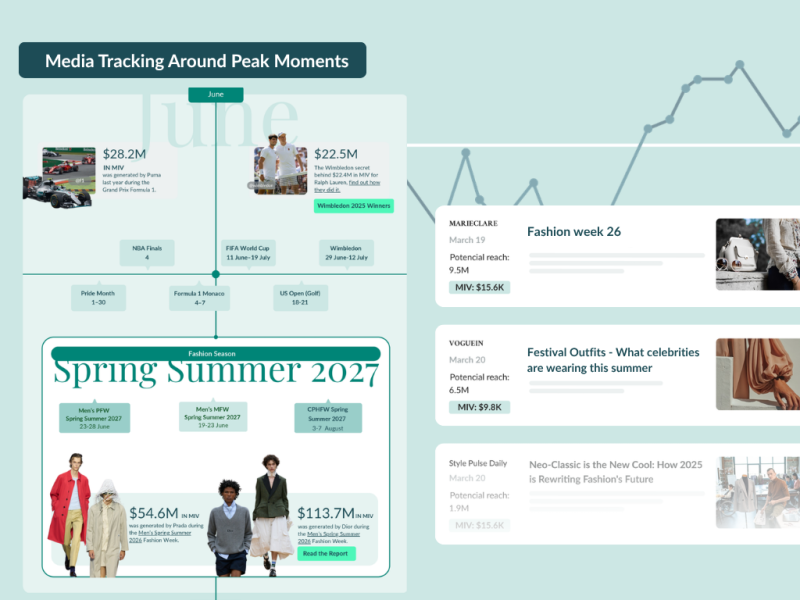
Start with the full marketing, PR and events calendar and narrow it down to the moments your brand is investing in. That could include celebrity dressing, ambassador partnerships, event sponsorships, influencer activations, product/sample placements or media collaborations tied to major cultural moments. From there, identify the moments that require dedicated media tracking, for example:
Fashion: Fashion weeks, the Met Gala, Cannes and award season
Watches & Jewelry: Watches & Wonders, the Oscars, Cannes and celebrity red carpet moments
Beauty: Coachella, the VMAs, Grammy and Oscar season and Pride Month
Lifestyle and Sports: Wimbledon, Formula 1, the US Open and NBA Finals
The Press Cheat Sheet Infographic
Pair major moments with data to inform your marketing and PR strategies.
Once those key moments are mapped out, brands need a reliable way to track performance across everything happening at once. Many marketing and PR teams still rely on fragmented media and social media tracking tools, alongside surface-level metrics like brand mentions, reach or engagement. This makes it difficult to understand what’s actually driving meaningful brand value.
Launchmetrics Brand Performance Cloud was built specifically for FLB brands, combining media monitoring with competitive benchmarking across print, online and social channels. Its AI-powered technology measures both the quality and quantity of placements using Media Impact Value® (MIV®)as a standardized metric. This is where MIV becomes more useful for FLB brands than traditional media tracking metrics.
What is Media Impact Value® (MIV®)?
Media Impact Value® (MIV®) is Launchmetrics’ proprietary metric that assigns a monetary value to every placement to quantify media impact. It measures performance across channels, markets and Voices—Celebrities, Influencers, Media, Partners and Owned Media—allowing brands to compare placements consistently across every type of coverage.
Whether it’s an influencer TikTok post or a feature in Vogue, MIV creates a unified framework and puts all placements on a level-playing field for easy comparison.
Example of MIV in Practice
During Coachella 2026, Dior stayed part of the conversation through multiple celebrity moments. Sabrina Carpenter’s four custom Dior looks generated $3.6M in MIV, with $3M coming from social media alone. Her Instagram post drove $1.4M in MIV, while Vogue coverage added a further $557K.
Rather than only showing that Dior was mentioned a lot during Coachella weekend, MIV showed where the brand’s value was actually coming from—from Sabrina Carpenter’s social posts to high-impact media coverage.
If your brand generates $10M in MIV during fashion week, is that strong performance or are competitors generating double the impact?
Benchmarking helps brands understand how they are performing against competitors, similar cultural moments and their own past activations. This gives teams clearer context around what’s working, where they’re strongest and which strategies are consistently driving attention.
For example, if your brand performs strongly around sports moments like the WNBA Draft but sees weaker results during music-driven moments like the VMAs, it may suggest your ambassadors, audience or channel mix resonate more naturally in certain spaces.
How Teams Benchmark Performance
Launchmetrics allows brands to benchmark performance in three key ways depending on the level of analysis needed:
Industry View: Compare your brand against the wider market across a specific event, category, Voice or region
Competitive Benchmarking: Compare performance directly against selected competitors across events, channels, Voices and markets
Brand Deep Dives: Analyze a single brand in detail to understand which placements, celebrities, influencers and channels generated the strongest MIV
Example
Going into fashion week, knowing that Valentino generated $54M in MIV at PFW FW25 while Dior generated $119M gives teams a clear benchmark for what strong performance looked like during the previous season. Teams can also compare those results against how the same brands performed at the Met Gala, Cannes or award season to understand where different strategies resonate most strongly.
Build Your Media Tracking Workflow
The strongest media tracking strategies are built before the event begins, so teams can track performance as the moment unfolds instead of trying to piece everything together afterwards. Our PR Monitoring & Reporting Survival Guide explores this process in more detail, however, we’ve provided a high-level view of how teams can set up media tracking before and during major cultural moments.
Step 1: Define What You’re Tracking with Tagging
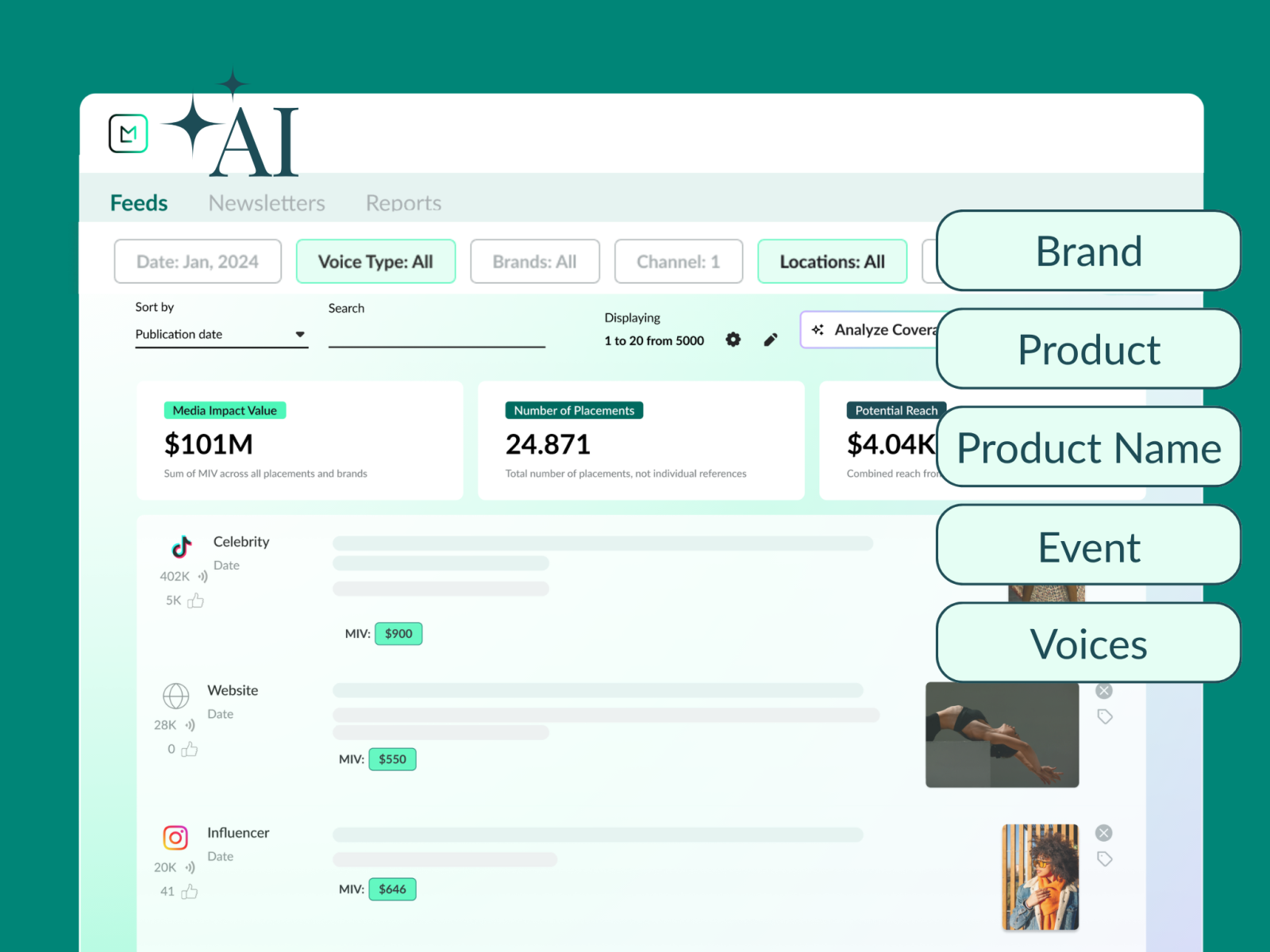
Coverage during major cultural moments quickly spreads across multiple markets, Voices and channels, making structure essential from the outset. Tagging helps teams organize placements by campaign, product, ambassador, event, region or topic, ensuring coverage is categorized as it comes into the Launchmetrics platform rather than manually sorted afterwards.
Tags can be applied manually or automated using keywords and filters. For recurring campaigns, activations or product launches, automatic tagging helps keep coverage consistently organized as it’s captured, making post-event reporting and coverage book creation significantly faster and easier.
Step 2: Use Voice Echo Tagging for Indirect Coverage
A celebrity post rarely stops with the original placement. Once coverage begins spreading across media articles, influencer reposts and social conversation, brands often generate far more visibility than the first post alone. Voice Echo Tagging helps teams track this indirect coverage across channels, making it easier to understand how an ambassador appearance, campaign or activation continues building attention and value for the brand beyond the original mention.
Step 3: Narrow the View with Filters
Once tracking is structured, filters help teams focus on the coverage that actually matters. Instead of manually scrolling through thousands of placements, teams can isolate performance by market, Voice, channel, campaign, product, publication or timeframe.
For example, during Fashion Week a luxury fashion brand could filter Celebrity Voice coverage in France during the first 48 hours after a runway show to understand which front row appearances generated the strongest media attention for the brand.
Step 4: Build Feeds for Ongoing Monitoring
Once your tagging and filtering structure is in place, these views can be saved into feeds—monitoring setups that automatically update as new coverage comes in throughout the event lifecycle.
Keeping all coverage, media tracking and reporting within one platform helps teams work from the same consistent data set, while still allowing regional teams, agencies or stakeholders to create feeds tailored to their own priorities. Here’s how that could look:
Before the event: teams can build feeds to monitor buildup of the event, campaign or ambassador partnership
During the event: feeds provide an up-to-date view of which placements, Voices and channels are generating the most MIV and momentum as conversation unfolds online
After the event: teams can track how MIV continued building over key reporting windows—such as the first 24 or 48 hours—to understand and report on how coverage and conversation carried on beyond the original moment
Once the event has unfolded, teams can compare performance against the benchmarks set beforehand. This helps brands understand how they performed relative to competitors, previous editions of the same event and their own past activations throughout the year.
Using Launchmetrics’ brand tracking solution, teams can compare up-to-date MIV performance across brands, Voices, channels, regions and events to understand who generated the strongest results during the moment and how performance evolved over time. This post-event analysis helps teams identify:
Which brands generated the most MIV overall
Which Voices and channels drove the strongest performance
Which placements or ambassador appearances outperformed expectations
How performance evolved across reporting windows like the first 24 or 48 hours
Whether coverage and conversation continued building after the original moment itself
Without this comparative view, brands may understand their own coverage, but miss the wider context of how they actually performed relative to the rest of the conversation.
Step 6: Report on ROI & Share Coverage
Once the event ends, the focus shifts from monitoring coverage to reporting on what actually happened. This is where leadership teams aren’t looking for a list of thousands of placements or screenshots—they want a clear view of performance, ROI and which strategies generated the most value for the brand.
For instance, let’s say within 48–72 hours of a major cultural moment, teams should be able to report on:
Which placements generated the most MIV
Which celebrity or ambassador appearances overperformed
Which Voices and channels drove the strongest results
Which markets generated the most impact
How performance compared against competitors and benchmarks
How MIV evolved across key windows like the first 24 or 48 hours
Instead of manually pulling screenshots and spreadsheets together, Launchmetrics keeps all coverage, media tracking and benchmarking in one place. This makes it easier for teams to build structured reports and coverage books using the same reliable data for more consistent reporting.
Coverage Books: These give teams a fast, shareable view of the brand’s top-performing placements filtered by MIV. Instead of manually compiling screenshots, teams can quickly build clean coverage summaries and automate updates throughout the event lifecycle.
Brand Performance Reports: These provide a deeper breakdown of performance across rankings, Voices, channels, regions and top placements. Using MIV, teams can understand where the most brand value came from and how performance evolved throughout the event.
Cultural Moments Move Fast—Your Media Tracking Should Too
The brands winning cultural moments today aren’t necessarily the ones spending the most. They’re the ones measuring performance clearly enough to understand what actually drives attention, influence and long-term brand momentum.
Launchmetrics gives Fashion, Lifestyle and Beauty brands the media monitoring, competitive benchmarking and reporting tools needed to turn every activation into measurable brand performance. Book a demo with our experts to learn how it can help you.
Ready to take your media tracking to the next level?
Learn all about your brand performance with our solution experts.
Pawandeep Kaur is a Fashion, Lifestyle and Beauty content expert and Senior Content Marketing Manager at Launchmetrics, with over seven years of experience in content marketing and thought leadership across retail, ecommerce and the Fashion, Lifestyle and Beauty market. She specialises in brand visibility, influence and cultural relevance across key cultural moments, marketing campaigns and events, translating performance data into strategic insight for the FLB market.
Across her career, she has led content, thought leadership and customer case studies in collaboration with global brands and agencies including KIKO Milano, Clarins, Pets at Home, Amazon, eBay and AKQA, helping brands translate strategy, performance and customer success into industry stories.