Each year, the Super Bowl stands as one of the biggest cultural moments on the calendar. Part sporting event, part entertainment stage, the Big Game consistently draws massive audiences. This year’s event at Levi’s Stadium was no exception, drawing 124.9 million viewers and becoming the second-most watched telecast in U.S. history as the Seattle Seahawks defeated the New England Patriots. That level of visibility makes the Super Bowl one of the most competitive stages in global marketing.
One global artist in particular dominated the conversation. Bad Bunny’s historic halftime performance generated unprecedented buzz. The fashion, sportswear and jewelry brands he chose to wear also became part of the narrative.
Between halftime show sponsorships, celebrity partnerships and strategic product placements, aligning with the Big Game comes at a significant cost. The question is: what’s the return?
That’s where Launchmetrics’ Media Impact Value® (MIV®) comes in. As an industry-recognized metric, it assigns a monetary value to every brand mention across online, social and print. MIV is used as a consistent way of measuring impact across Voices, channels, regions and events like the Super Bowl.
According to Launchmetrics data, the returns were significant.
Super Bowl LX generated $1.8B in MIV, making it one of the most impactful moments of the year.
In this blog, we break down the brands that won big, led by the performance that defined the night: the Benito Bowl.
The Benito Bowl, By The Numbers
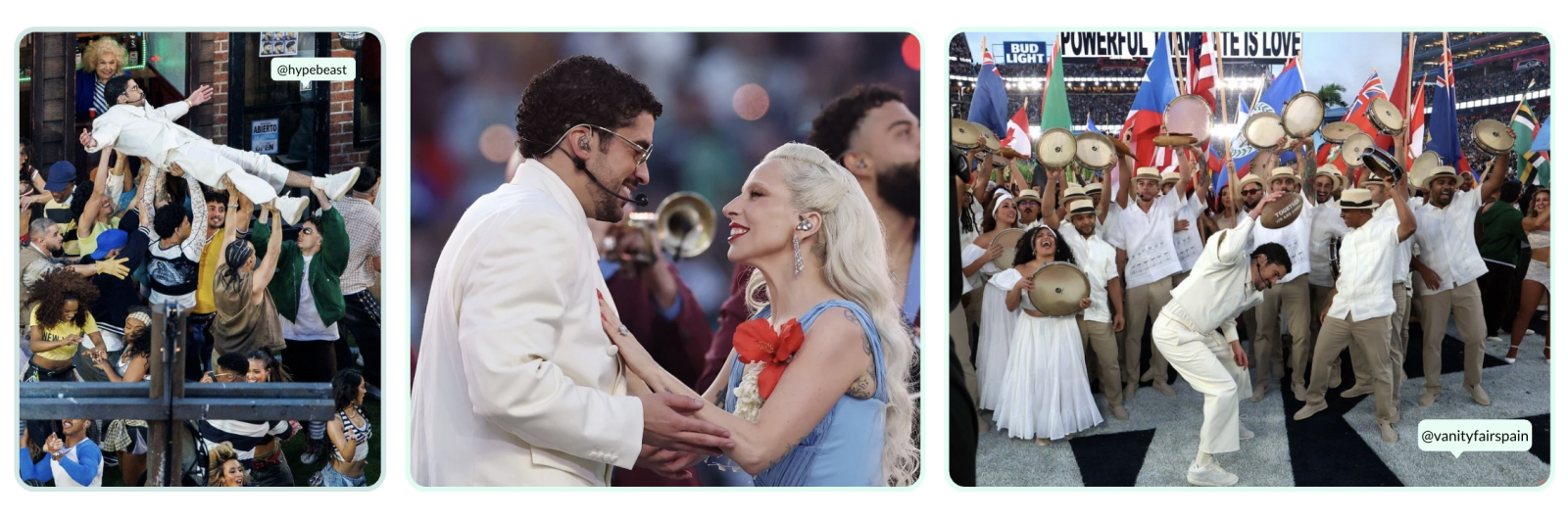
For 13 minutes on Sunday night, Bad Bunny turned Levi’s Stadium into La Casita. Performing entirely in Spanish (a Super Bowl first), the Puerto Rican superstar brought sugarcane fields, domino tables, piragua vendors, bomba dancers and celebrity appearances to the halftime show. Notably, he carried the Puerto Rican independence flag during “El Apagón” and created a cultural celebration that resonated far beyond the field.
As a result, Bad Bunny’s performance drove $942.4M, that’s 52% of the entire event’s MIV.
For context, conversations tied to Bad Bunny drove nearly $1B, twice the value of September’s New York Fashion Week and delivered nearly six times the impact of Rihanna’s widely celebrated halftime show.
Where Did Media Impact Come From?
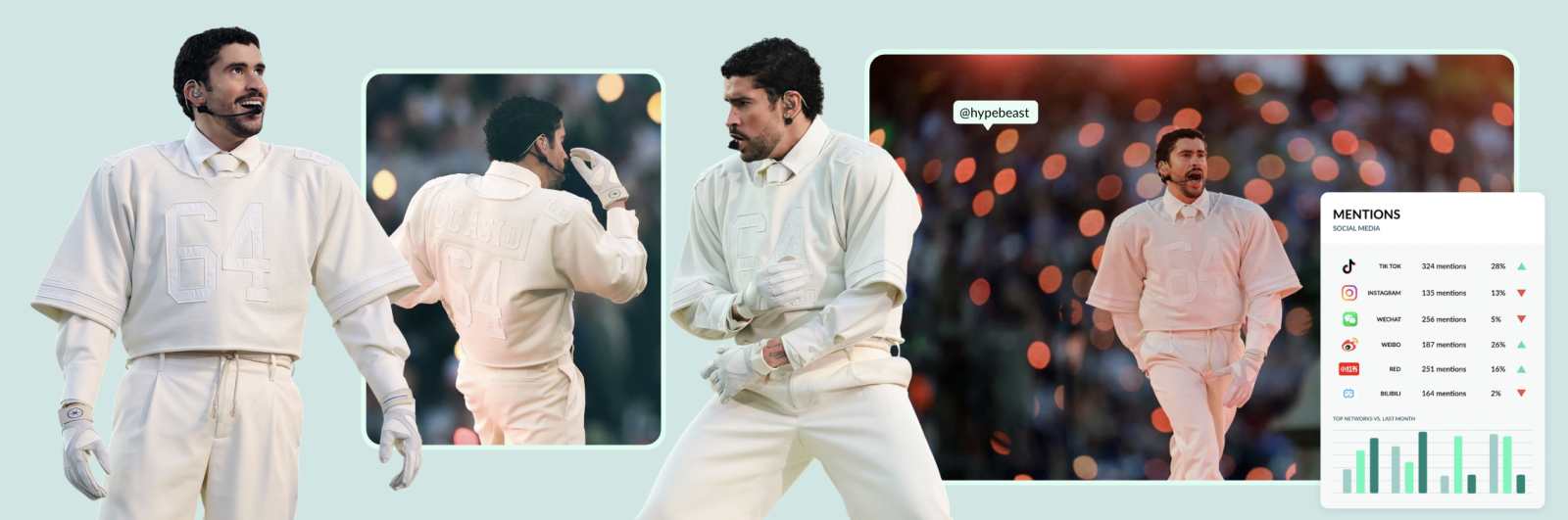
For the entire event, social media led the charge, accounting for $1.6B of the total Super Bowl conversation. The event exploded across platforms; Instagram dominated among platforms with $576M MIV, followed by Facebook at $471M and TikTok at $349M. This was driven by fans, who immediately dubbed it “The Benito Bowl” on social media, with viral content emphasizing they’d tuned in for Bad Bunny, rather than the game itself.
Amplifying the conversation across channels were media and publications. This comes as no surprise, as Launchmetrics data revealed that Super Bowl event coverage continues to grow yearly due to coverage from the Media Voice. (It’s why we highlight it as a key event on Launchmetrics’ Press Cheat Sheet: our calendar of moments PR and marketing pros can’t miss.)
In this year’s Super Bowl, Media Voices generated $1.4B MIV, with major outlets including The New York Times, The Guardian, Vogue, WWD and Business Insider all running extensive coverage analyzing the performance’s cultural significance, the brands Bad Bunny wore and what it meant for representation.
The verdict? This was the most powerful MIV-driving halftime performance in Super Bowl history and the brands who were alongside him won big.
Let’s take a look at the brands that generated the most impact.
Bad Bunny Opts for Zara, Sparking $19.9M in MIV
Luxury brands typically dominate the Super Bowl halftime show. But Bad Bunny had other plans.
Rather than opting for a theatrical look from a luxury fashion brand, he chose Zara for a more personable look. Appearing in a custom all-cream ensemble featuring a collared shirt, tie, sport-inspired jersey and chinos, the decision paid off. In a single performance, Bad Bunny generated $19.9M in MIV for the brand. Emblazoned with “Ocasio 64” in tribute to his late uncle Cutito, the jersey became an instant talking point, with fans dissecting the meaning behind every detail.
This marked Zara’s first time outfitting a Super Bowl halftime performance, dressing Bad Bunny, his dancers, band and orchestra. At the same time, the Spain-based brand dressing the first artist to perform a halftime show entirely in Spanish created a full-circle moment. While Bad Bunny brought Puerto Rico to the Super Bowl, Zara delivered the visual identity and language to match.
The momentum extended beyond the performance. Limited-edition shirts given to select Inditex employees (Zara’s parent company) started appearing on resale platforms within days—with some listings reaching nearly $35,000. The shirts came with a note from Bad Bunny praising the “time, talent and heart” behind the project and tags stating the garment was not intended for sale.
For marketers, the takeaway is clear: cultural authenticity can generate luxury-level impact. Zara demonstrated that when an accessible brand aligns credibly with an artist’s vision, it can command both attention and value.
The Accessories That Amplified Bad Bunny’s Moment
Adidas: $7.7M From Strategic Timing
Adidas and Bad Bunny have been collaborating since 2021, remaking models like the Gazelle and Adizero SL 72. This Super Bowl moment marked the culmination of years of partnership, introducing Bad Bunny’s first signature sneaker to a global audience.
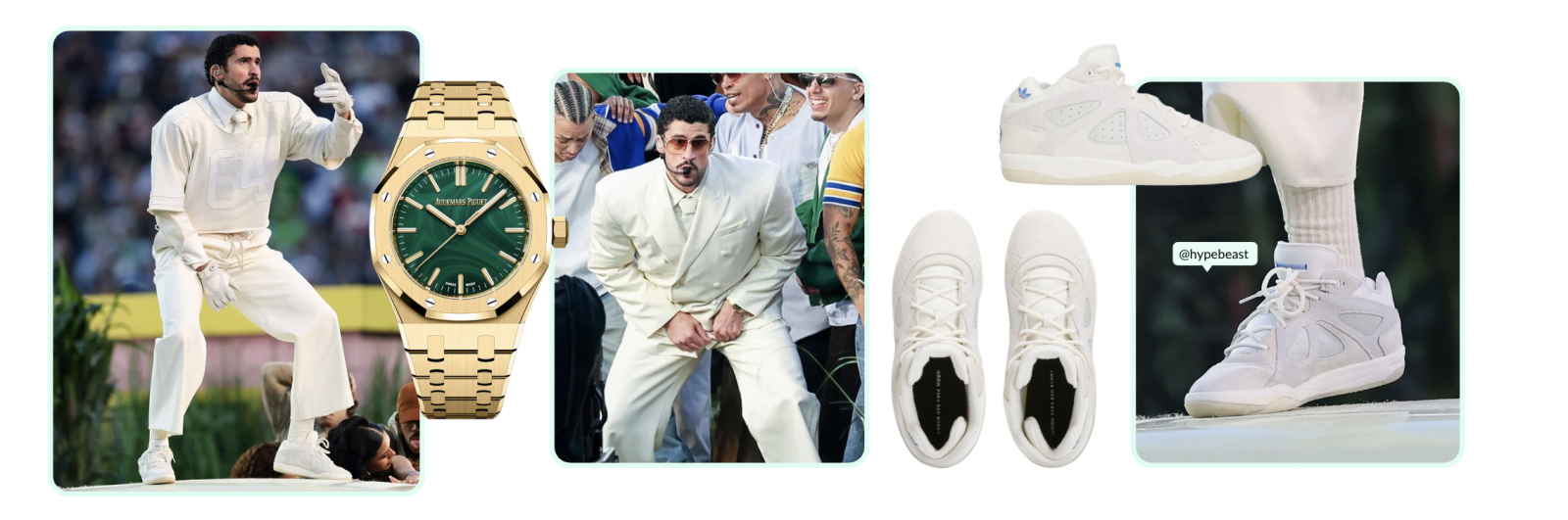
The BadBo 1.0 launched officially on February 2, the morning after Bad Bunny won three Grammys, in a brown colorway limited to 1,994 pairs (nodding to his birth year) that sold out immediately. During his performance at the Super Bowl, Bad Bunny debuted an all-white colorway of the sneaker, generating $7.7M MIV for Adidas. The all-white “Resilience” colorway worn at the Super Bowl was dropped by the brand the day after his halftime performance, capitalizing on the “Benito Bowl” momentum.
Bad Bunny’s dancers also wore Adidas throughout the show, sporting white and black Sambas and Bad Bunny’s Ballerina sneakers, creating cohesive brand integration across the entire performance.
Audemars Piguet: $2.3M in Subtle Luxury
While Zara and Adidas made bold statements, Audemars Piguet took a quieter approach. To finish off his look, Bad Bunny wore a Royal Oak Selfwinding 37mm in 18-karat yellow gold with a malachite stone dial, generating $2.3M MIV.
This drove watch enthusiasts to immediately start screenshotting and identifying this exact piece. Publications like Time+Tide Watches and Wallpaper ran detailed breakdowns of the Royal Oak, with Audemars Piguet confirming the model to Time+Tide.
For marketers, the lesson is clear: when your audience cares enough to do the detective work, the impact follows.
Lady Gaga’s Luar Moment
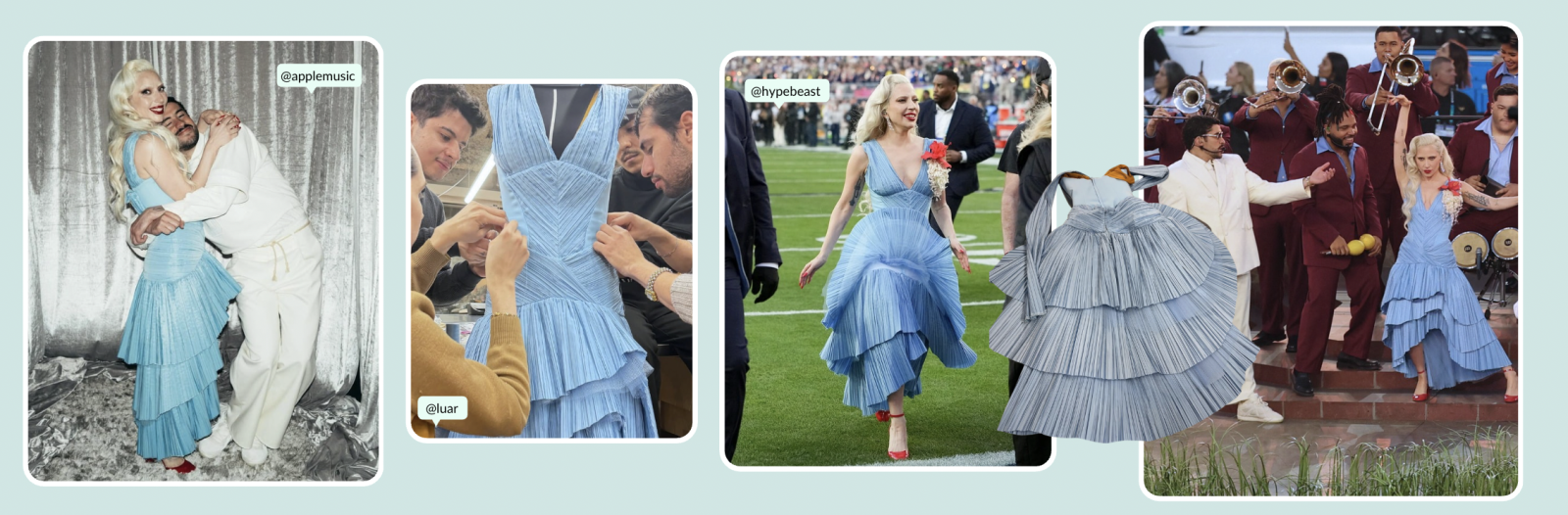
While accessible fashion dominated with Bad Bunny’s choices, luxury made its way back to the stage through Lady Gaga. Her surprise appearance added another layer to the night’s cultural significance. Gaga’s performance of “Die With a Smile” (salsified with Los Sobrinos) generated $131M MIV, proving that even in someone else’s show, she knows how to make a moment. And brands once again know how to leverage it.
Her custom baby blue flamenco dress by Luar generated $4.7M MIV for the Dominican-American designer. The dress, complete with a flor de maga brooch (Puerto Rico’s national flower) by Piers Atkinson and Chopard jewelry ($727K MIV) was a love letter to Caribbean culture.
Designer Raul Lopez, who founded Luar in 2011, told Vogue: “I designed this dress for the Caribbean women I grew up watching, listening to, and being shaped by.” The internet affectionately called her “Tití Gaga” and Lopez confirmed he’s already working on making the dress available to a wider audience.
What Brands Can Learn From the Benito Bowl
Bad Bunny’s Super Bowl performance offers several strategic lessons to luxury and accessible fashion labels looking to maximize impact around cultural moments:
- Cultural fit matters more than budget size: From Zara to Audemars Piguet, every brand in Bad Bunny’s ecosystem generated meaningful MIV. The common thread is that each partnership felt authentic to the moment. When the alignment is right, price point becomes secondary.
- Authenticity drives measurable results: Zara allowed Bad Bunny to be himself: cream-on-cream, family name on the back and honoring his late uncle. The result? Genuine partnerships outperform transactional celebrity endorsements.
- Historic moments carry different weight: The first entirely Spanish-language Super Bowl halftime show was always going to generate coverage. Brands that aligned with this milestone benefited from the cultural significance, not just the audience size. These moments prove their value year after year because audiences are already invested. It’s important to identify the ones where that emotional buy-in already exists.
The Bottom Line
Bad Bunny’s $942.4M MIV impact reflects what happens when brands move with the moment. At major sporting events where audiences are deeply invested, brands that win are those that align with the people and emotions at the center of it.
The Benito Bowl showed how integration creates value. When brands become pieces of self-expression, reflecting personal stories and cultural pride, they shift from placements to parts of the narrative itself. That’s where measurable impact lives.
For PR and marketing professionals, this is the blueprint: cultural moments reward brands that show up with intention.
Want to understand how your brand can measure and maximize cultural moments?
Download our MIV Guide to learn how leading brands measure impact across all their marketing activations.

Discover More About Media Impact Measurement for Fashion, Lifestyle and Beauty Brands

By Luna Weissman